

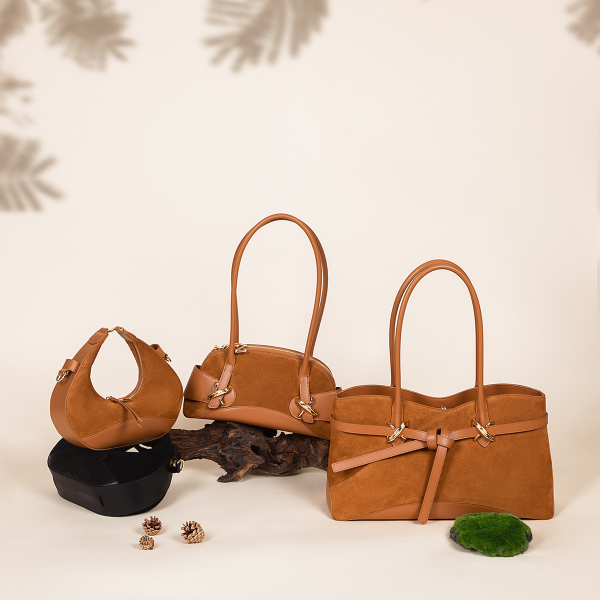
מאמר: Full Grain vs Top Grain vs Bonded: Which Is Best for Handbags?
Full Grain vs Top Grain vs Bonded: Which Is Best for Handbags?
Two handbags sit side by side in your browser. Both say "real leather." One costs $89, the other $389. And if you're like most shoppers, you close the tab more confused than when you opened it.
Here's the thing. "Real leather" isn't one material. It's a family, and within that family, the grades vary more than most people imagine. A full-grain bag and a bonded-leather bag can both legally say "genuine leather" on the label, yet one will outlive you and the other will peel by its third birthday.
In this guide, we'll walk through what actually separates full-grain, top-grain, genuine, and bonded leather, what each one costs, how each one ages, and which one deserves your money when you're buying a handbag. We make leather bags for a living, so we'll skip the marketing fluff and tell you what the tannery guys say.

The 30-Second Answer: Leather Grades at a Glance
Short on time? Here's the whole hierarchy in one table. The rest of the article explains why the gaps are bigger than they look.
| Grade | What it actually is | Durability | Price tier |
|---|---|---|---|
| Full-grain | Top layer of the hide, untouched, grain intact | Decades | $$$ |
| Top-grain | Top layer, sanded smooth to remove flaws | 10+ years | $$ |
| Genuine | Real leather, but the bottom of the real-leather ladder | A few years | $ |
| Bonded | 10–20% leather scraps glued with polyurethane | Peels in 1–3 years | Bargain bin |
Why Leather Even Has Grades

To understand the grades, picture a cowhide in cross-section. The top layer, the part that did all the living, is called the grain. It's dense, tight, and strong, because it was the animal's first line of defense against weather and scratches. Below it sits the split, a looser, fuzzier layer that was never exposed to the elements.
The best hides, the ones with few scars and a tight grain, become full-grain leather with almost no processing. Hides with more marks get sanded down to become top-grain. The looser split layers get coated and stamped to look like the real thing, and that's where "genuine leather" in its cheapest form comes from. Whatever scraps remain get shredded, mixed with glue, and rolled into sheets of bonded leather.
One hide, four very different products. And only the marketing sounds the same.
Full-Grain Leather: The Gold Standard

Full-grain is the whole top layer of the hide with the grain surface left completely intact. No sanding, no buffing, no corrections. If the cow had a scratch from a fence, you'll see a faint trace of that scratch in your handbag.
That sounds like a flaw, but it's the opposite. Because the grain was never broken, the fiber structure stays at full strength, which is why full-grain is the most durable leather you can buy. And over the years, it develops patina, a soft sheen and deepened color that makes the bag look better at year ten than it did at day one. Cheap leather ages. Full-grain matures.
The trade-offs? Full-grain costs the most, since only the best 10–20% of hides qualify. It starts out stiffer, and it needs occasional conditioning to stay at its best. If you want a bag that looks factory-perfect forever, this isn't it. If you want a bag that becomes uniquely yours, it is.
Best for: a daily handbag you plan to keep (and maybe pass down). The bag you buy once.
Top-Grain Leather: The Polished Runner-Up

Top-grain starts as the same top layer, but the surface gets lightly sanded to remove scars and imperfections, then finished with a thin coating. The result is smoother, more uniform, and slightly thinner than full-grain.
This is the leather you'll find in most mid-range and many high-end designer bags, and honestly, that's not a scandal. Sanding costs you some durability, since it weakens the outermost fibers, and patina develops more slowly and more subtly. In exchange you get a bag that's lighter, softer from day one, and more resistant to water and stains thanks to the finish.
Think of it this way: full-grain is the raw diamond, top-grain is the cut and polished one. Both are diamonds. One just had more intervention.
Best for: someone who wants a refined, uniform look and lower maintenance, without dropping to the bottom grades.
Genuine Leather: The Term That Fooled Everyone

Here's where words do the heavy lifting. "Genuine leather" sounds like a promise of quality. It's actually a technical statement: yes, this is real leather. That's all it promises.
In practice, most products marketed as genuine leather are made from the lower-quality layers of the hide, heavily sanded to erase every natural mark, then stamped with an artificial grain pattern and sealed under a thick coating of pigment. Look closely and the "pores" repeat in a pattern, because they're printed, not grown.
It's still real leather, and a well-made genuine-leather bag will still outlast any synthetic. But it won't develop real patina, the coating can crack over years of flexing, and it's usually thinner. When a $60 bag screams "GENUINE LEATHER" in gold foil, that's the grade it's proud of.
Best for: tight budgets, or styles you don't expect to keep for a decade. Just don't pay top-grain prices for it.
Bonded Leather: Not Really Leather at All

Bonded leather is to leather what particle board is to oak. It's made by shredding leather scraps and leftover fibers, mixing them with polyurethane binder, and rolling the paste into sheets. The leather content is typically 10–20%. The rest is plastic and glue.
Fresh out of the box, bonded leather looks convincing. Give it one to three years of sunlight, friction, and everyday flexing, and the binder breaks down. The surface starts flaking at the edges, then peels in sheets, then cracks. There's no conditioning your way out of it, because there's nothing left to condition.
Legally, brands can often describe bonded products as "made with real leather," which is technically true and practically misleading. If you see a "leather" handbag under $60, or a "leather" sofa at a suspicious price, bonded is almost always the answer.
Best for: nothing, if you care about durability. We said we'd skip the fluff.
Head to Head: The Comparison That Matters

| Factor | Full-grain | Top-grain | Genuine | Bonded |
|---|---|---|---|---|
| Realistic price (bag) | $250+ | $120–300 | $50–120 | Under $60 |
| Expected lifespan | 20+ years | 10–15 years | 3–7 years | 1–3 years |
| How it ages | Patina, looks better | Slow, subtle patina | Coating wears, dulls | Peels and cracks |
| Feel on day one | Firm, textured | Smooth, supple | Coated, uniform | Thin, plasticky |
| Care needed | Condition 2x/year | Condition 1x/year | Wipe clean | Nothing helps |
So Which One Should Your Handbag Be?
Three honest answers, depending on you:
If you want one bag for the next decade: full-grain, full stop. It's the only grade that rewards time instead of fighting it. Buy the stiffer bag on day one, condition it twice a year, and by year three it will fit your hand like it was made for it. Because it was.
If you rotate bags with your outfits: top-grain makes a lot of sense. It's lighter, softer from the start, shrugs off rain better, and you're not stressing a single bag daily anyway. You give up a little lifespan for a lot of convenience.
If the budget is genuinely tight: a well-constructed genuine-leather bag beats any synthetic at the same price, and that's a fair deal. Just buy it knowing what it is, check the stitching and lining quality, and expect years, not decades.
And bonded? Walk away. A $50 bonded bag you replace every two years costs more than one $300 full-grain bag kept for twenty.
Whatever you choose, don't take the label's word for it. We've put together seven at-home tests to tell real leather from fake, and the raw-edge check in particular will expose a bonded pretender in seconds.

At ZORNNA, we only work in full-grain leather from traceable tanneries, because we'd rather explain a higher price once than apologize for peeling edges forever. Every bag ships with a leather certificate stating its grade, and our craftsmen inspect each hide before a single stitch is sewn.
Shop Full-Grain Leather BagsP.S. Not sure where to start? Our free Ultimate Leather Bag Buying Guide walks through budget, style, and care in one checklist.
Frequently Asked Questions
Is full-grain leather worth the extra money?
For a bag you'll use regularly, yes. Full-grain typically lasts 20+ years and develops patina instead of wearing out, so its cost-per-year is often lower than cheaper grades. For occasional-use styles, top-grain can be the smarter spend.
Is top-grain leather good quality?
Very. It's the second-highest grade, made from the same top layer of the hide, just sanded smoother. Most premium designer bags use top-grain. You trade a little durability and patina for a lighter, more uniform finish.
What's the difference between genuine leather and full-grain leather?
Both are real leather. Full-grain is the top grade, the untouched surface of the hide's strongest layer. "Genuine leather" typically refers to lower-quality layers, sanded and heavily coated. It's the bottom rung of the real-leather ladder.
How long does bonded leather last?
Usually one to three years. Bonded leather is 10–20% leather fibers bound in polyurethane, and once the binder breaks down from sunlight and flexing, the surface peels and cracks. It can't be restored.
Does full-grain leather scratch easily?
It shows scratches, because the natural surface isn't covered by a heavy coating. But most light marks rub out with your fingertip's natural oils or a little conditioner, and over time they blend into the patina.
Which leather is best for a handbag?
Full-grain for a daily keeper, top-grain for a lighter, lower-maintenance option, well-made genuine leather on a tight budget, and never bonded. Choose based on how long you plan to keep the bag.
The Bottom Line
Leather grades aren't snobbery, they're physics. The intact grain layer is simply the strongest material a hide can give you, and every step down the ladder trades away structure, first a little, then a lot, then everything.
So the next time two "real leather" bags sit side by side at wildly different prices, you won't be confused. You'll know exactly what changed between them, and you'll know which one deserves your money.
 Author: Seuruyalvi - Chief Designer
My name is Seuruyalvi, as the chief designer at ZORNNA, I am responsible for overseeing the creative direction of the brand, from conceptualization to final product design.
פוסטים של בלוג
Full Grain vs Top Grain vs Bonded: Which Is Best for Handbags?
Two handbags sit side by side in your browser. Both say "real leather." One costs $89, the other $389. And if you're like most shoppers, you close the tab more confused than when you opened it. Her...
לקרוא עוד
איך לדעת אם תיק עור אמיתי: 7 בדיקות שתוכלו לעשות בבית
איך לדעת אם תיק עור אמיתי: 7 בדיקות שתוכלו לעשות בבית עשית הכל נכון. חסכת, קראת את הביקורות, השוואת מחירים, ולבסוף קנית את מה שהמודעה כינתה תיק עור אמיתי. שלושה חודשים לאחר מכן, הפינות מתקלפות והמש...
לקרוא עוד
【עור פרה שזוף צמחי】כתם מים על תיק העור שלך? מדריך ההצלה מגשם של ZORNNA
למה מים משאירים סימנים על עור? אחת הסיבות לכך שנשים אוהבות את עור הפרה השזוף צמחי של ZORNNA היא יופיו הטבעי. בניגוד לעור המצופה בכבדות, עור שזוף צמחי שומר על נקבוביות גלויות ומבנה נושם המפתח פטינה ...
לקרוא עוד
